
Introduction
In modern office environments, prolonged sitting has become the norm. However, the health problems caused by prolonged sitting, such as lower back pain and neck discomfort, have attracted increasing attention.
To improve work comfort and health, riser desks have become a new favorite in many offices, with brands like Meet&Co being particularly popular.
They not only enhance the work experience but also help employees maintain a more efficient and healthy work environment. So, what is a riser desk?
This article will provide a comprehensive overview of riser desks, including their definition, benefits, features, types, and recommended products on the market, and will help you distinguish between a “riser desk” and a “desk riser.”
Table of Contents
- Introduction
- What Is A Riser Desk?
- The Benefits Of Using A Riser Desk
- 5 Features Of Rise Desk
- Types Of Riser Desks
- 5 Best Riser Desks Recommended
- Riser Desk VS Desk Riser
- Conclusion: What Is A Riser Desk?
- FAQ
What Is A Riser Desk?
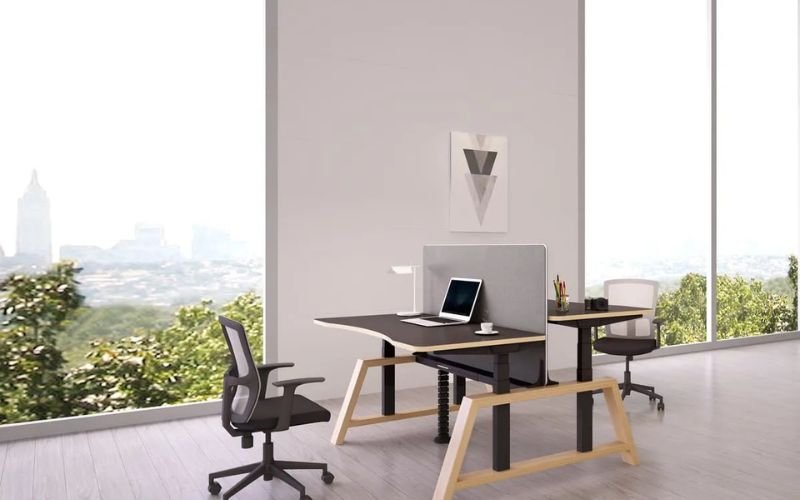
A riser desk, also known as a height-adjustable office desk, is a type of desk whose desktop height can be adjusted according to the user’s needs, allowing the user to switch between sitting and standing postures freely.
It is typically equipped with an electric or manual height-adjusting mechanism, enabling flexible desktop height adjustment.
Its main components include the desktop, support frame and height-adjusting mechanism, base and stabilization system.
Its primary applications are corporate offices, home offices, creative studios, and health management.
It breaks away from the fixed model of traditional desks, making the office environment more flexible, comfortable, and personalized.
For modern office workers, a height-adjustable desk is no longer just furniture, but also a “healthy office tool.”
The Benefits Of Using A Riser Desk
Using a riser desk is more than just a trend. It offers numerous benefits for those working from home or in the office.
Here are some of the significant benefits of using a height-adjustable desk:
1. Improved Posture
Maintaining the same posture for extended periods easily leads to slouching or hunching. To avoid this, standing up can effectively reduce pressure on the lumbar and cervical spine.
Experts recommend following the 20:8:2 rule: sit for 20 minutes, stand for 8 minutes, and then do 2 minutes of exercise, such as stretching or walking.
2. Reduced Back, Lower Back, and Neck Pain
In fact, sitting can put up 90% more pressure on the intervertebral discs than standing.
However, when standing, the spinal load is more evenly distributed, and the natural curve of the lumbar spine is better maintained.
The body is more likely to maintain a natural, upright posture, thus relieving pressure on the back, lower back, and neck.
3. Burn More Calories and Reduce the Risk of Obesity
Studies show that standing while working burns approximately 50-100 more calories per hour than sitting. Over the long term, this can help with weight control.
Standing while working can promote blood circulation and increase muscle activity, thereby increasing the body’s basal metabolic rate and playing a role in reducing fat accumulation.
4. Maintain focus and mental alertness, improving work efficiency
When standing, blood circulation is smoother, delivering more oxygen and nutrients to the brain, thus maintaining alertness and focus.
The accompanying slight muscle activity can effectively reduce drowsiness and distraction, keeping you active throughout the day and improving work efficiency.
👉 To learn more about the benefits of using a standing desk, please continue reading: The Benefits of a Standing Desk
5 Features Of Rise Desk
1. Adjustable Height
Adjustable height is one of the core features of a standing desk, allowing the desktop height to be flexibly adjusted according to the user’s height, work tasks, and personal comfort needs.
Currently, standing desks are mainly divided into manual and electric adjustment methods. Manual standing desks typically adjust the height using a joystick, gas cylinder, or screw rotation.
However, electric standing desks use a simple touchpad to raise and lower the desktop. You can choose the type of standing desk that suits your individual needs and budget.
2. Health-Friendly
A 2015 study published in the European Heart Journal showed that prolonged sitting is associated with an increased risk of various diseases, including heart disease.
Switching to a standing desk is essential to alleviate the health problems caused by prolonged sitting.
It can reduce the continuous damage to the body from the root cause, and through scientifically adapted posture, it can greatly help relieve back pain and promote blood circulation to a certain extent.
3. Improve Focus
When sitting for long periods, the body’s metabolism slows down, reducing the efficiency of blood and oxygen supply to the brain.
Combined with relaxed muscles, the body is in a “low-energy” state, easily leading to drowsiness and lethargy, making it difficult to concentrate.
Switching to a standing position activates the body’s muscles, stimulating the sympathetic nervous system and switching the brain from “relaxed mode” to “awake mode.”
Simultaneously, faster blood circulation delivers more oxygen and nutrients to the brain, effectively relieving mental fatigue and reducing drowsiness and inattentiveness, allowing you to maintain a clear mind at work.
4. High Adaptability
The standing desk’s desktop design combines practicality and versatility, easily adapting to different types of office and study equipment, such as laptops, desktop monitors, tablets, mice, keyboards, and folders.
The spacious desktop allows for personalized placement. Furthermore, whether in an open workspace, a private office, or a small startup studio, the standing desk’s simple design and adjustable features quickly adapt to different workspace sizes and interior design styles.
Its wide height adjustment range allows both women (150cm tall) and men (190cm tall) to find a comfortable standing/sitting height.
5. Easy to Use
The standing desk’s ergonomic design makes height adjustment easy for different users. Whether you’re a woman or an elderly person, no professional knowledge is required, and you can use it immediately.
For the electric model, simply press a button to raise or lower the desktop. The manual model allows you to adjust the height using your body weight or a slight pushing force.
Whether manual or electric, the height adjustment of the standing desk can be completed within 30 seconds.
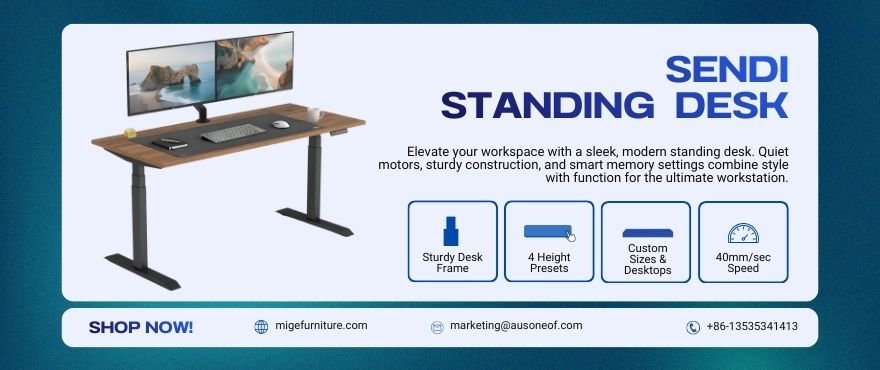
Furthermore, some electric models, such as the Sendi Electric Height Adjustable Office Desk, can preset 2-3 commonly used heights (such as sitting, standing, etc.), allowing you to simply press the corresponding button next time you use it, eliminating the need for repeated adjustments.
The adjustment buttons or handles are mostly located on the edge or side of the desktop, within easy reach, allowing operation without bending over or moving your body, further reducing the cost of use.
Types Of Riser Desks
Based on design and usage, riser desks can be mainly divided into the following categories:
Electric Height-Adjustable Desks
Electric height-adjustable desks rely on an electric motor. Users can adjust the desktop height via buttons or a remote control, making the operation simple and quick.
Advantages:
- No manual effort required, easy for the elderly and women to use.
- Wide height adjustment range (usually 70-120cm), adaptable to people of different heights.
- Smooth operation, low noise, won’t disturb others.
- Strong load-bearing capacity, can easily support heavy equipment such as desktop computers and printers.
Disadvantages:
- Higher price and requires a power connection to operate.
Manual Height-Adjustable Desks
Manual height-adjustable desks offer two adjustment methods: gas spring and hand crank. No power is required; height adjustment is achieved through human effort or mechanical structure.
Advantages:
- Compared to electric models, manual models are lower cost and offer better value.
- No power supply limitations, higher flexibility.
- Relatively simple structure and maintenance, strong durability.
Disadvantages:
- Requires some effort to adjust, and the lifting speed is slower.
Pneumatic Height-Adjustable Desks
Pneumatic height-adjustable desks use a gas spring to adjust the desktop height; the height automatically locks when the spring is released.
Advantages:
- No power required, usable in any setting.
- No hand cranking required, making adjustments easier and more convenient.
- Low noise due to the absence of a motor, suitable for quiet office or study environments.
- Lower price than electric models and more convenient than hand-cranked models, offering excellent value for money.
Disadvantages:
- Limited load-bearing capacity and narrow height adjustment range.
Also see: Best Desk Riser For Standing 2026: 5 Top Sit-Stand Options
Desk Riser
A desk riser is a lifting device that can be attached to an existing desktop. Electric models offer one-button height adjustment, while manual models allow for push-pull adjustment after unlocking; both can raise the desktop partially or entirely to standing height.
Advantages:
- Quick and simple installation, no need to disassemble the existing desk, completed in 10-30 minutes.
- Compared to completely replacing the desk, desktop height adjustment devices are more cost-effective.
- High flexibility; a height adjustment device can be found to match the size of the desktop.
- Foldable and retractable, saving space.
Disadvantages:
- The desktop may wobble or tilt when raised to a certain height.
L-shaped Standing Desk
L-shaped standing desks, such as the Sendi E L-Shaped Executive Standing Desk, are desktop designs with an L-shaped structure, typically divided into a main work area and a secondary work area, suitable for office environments requiring a large workspace.
Advantages:
- Spacious desktop space.
- L-shaped design fits snugly in corners, maximizing space utilization.
- Clear zoning for convenient and smooth use.
- Strong load-bearing capacity and stability, remaining stable even at maximum height.
Disadvantages:
- Large size, requires ample space, unsuitable for small apartments or compact workstations.
Double-Layer Height-Adjustable Desk
This desk features two independent desktops: the upper layer is the main work area, and the lower layer is for auxiliary storage. Both desktops can be raised and lowered simultaneously.
Advantages:
- Ample storage space. The lower desktop can hold documents, books, etc.
- Vertical tiered design for high space utilization, suitable for small apartments and compact workstations.
- Easy access. Items on the lower layer can be retrieved without bending or standing up.
- Double-layer structure for smoother raising and lowering.
Disadvantages:
- Not very user-friendly for taller individuals, and the gap between the upper and lower layers makes cleaning more time-consuming.
5 Best Riser Desks Recommended
1. Sendi Workstation Electric Height Adjustable Desk
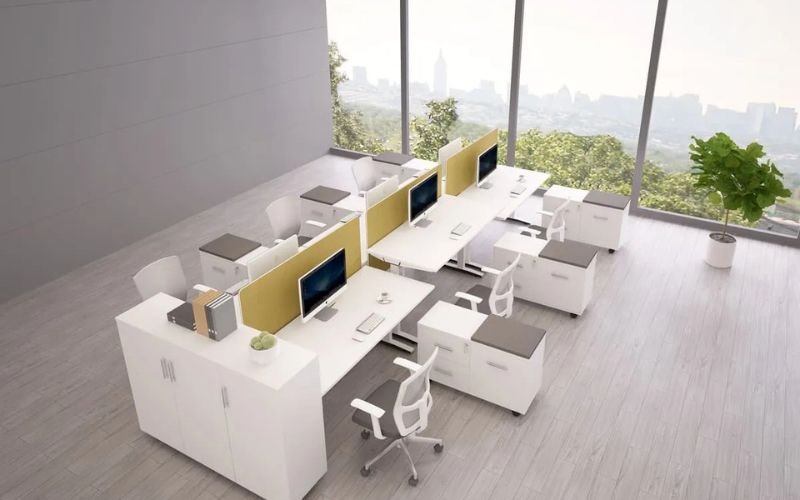
The Sendi Workstation Electric Height Adjustable Desk is renowned for its durability, stability, and extensive customization options.
From size and color to materials, you have complete freedom to personalize it. The 25.6–50.8 inch height adjustment range accommodates users from 150cm to 200cm tall.
Furthermore, the intuitive control panel allows you to quickly adjust the desktop to your ideal height without any technical expertise.
For creating a dedicated workspace, this desk offers an optional fabric partition, effectively enhancing privacy and focus while helping to absorb noise and create a quieter, more comfortable working environment.
It also features a memory preset function, allowing you to store multiple frequently used height settings and saving you the hassle of frequent adjustments.
Pros:
- Dual-motor configuration for excellent stability.
- Three-section uprights for a wide adjustment range to accommodate people of different heights.
- Operating noise level below 50 decibels, ensuring it won’t disturb those around you.
Cons:
- No storage space.
Specfications:
| Desktop Size | 1200*1200*610/1260H, 1400*1200*610/1260H, 1400*1400*610/1260H, 1600*1400*610/1260H, 1800*1400*610/1260H |
| Height Range | 25.6 – 50.8 inches |
| Maximum Weight | 450 pounds |
| Warranty | 3 years |
2. CoCo Sit-Stand Workstation
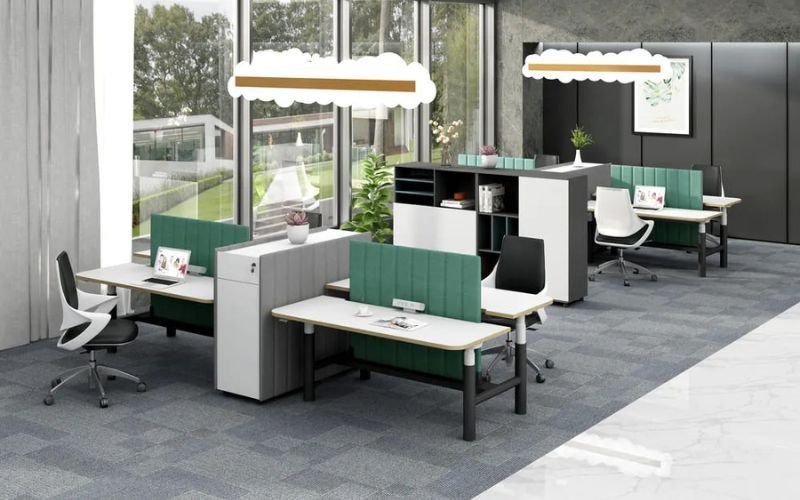
The CoCo Sit-Stand Workstation is a height-adjustable double-seat workstation with adjustable desktop height via buttons or levers on the control panel.
It offers four height settings to accommodate users of different heights. It also features a memory function, allowing you to save your preferred height to the control panel with a single touch.
This enables quick switching between sitting and standing positions without manual adjustment each time.
The three-section uprights and dual-motor design ensure smooth desktop height adjustment and strong load-bearing capacity while minimizing wobbling and noise, making the transition between sitting and standing positions more comfortable and safer.
Pros:
- E1-grade MFC panel, low formaldehyde emissions, safer to use.
- Multiple colors and sizes available.
- Snap-on sockets for easy installation and removal.
Cons:
- Requires self-assembly.
Specfications:
| Desktop Size | 1460*1230*700~1200mm |
| Height Range | 27.6 – 47.2 inches |
| Maximum Weight | 450 pounds |
| Warranty | 3 years |
3. Sendi E L-Shaped Executive Standing Desk
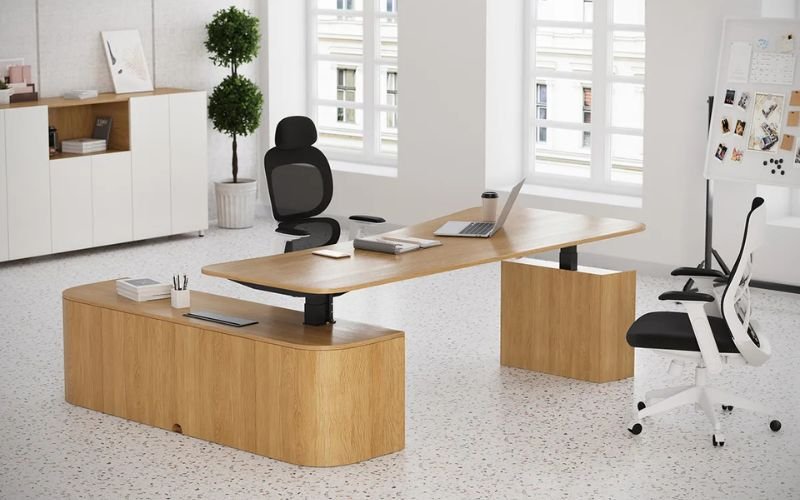
The Sendi E L-Shaped Executive Standing Desk features a sophisticated button-operated control panel for easy height adjustment with a single touch, requiring no special skills.
It also offers four memory presets, allowing you to easily change positions and avoid back pain from prolonged sitting, enjoying a more comfortable work experience.
Its L-shaped design and concealed side cabinets maximize space utilization, providing ample storage. You can neatly store documents, important items, and office supplies, maintaining a tidy and efficient workspace.
A sensitive anti-collision system detects obstacles and immediately changes direction, allowing you to work with peace of mind.
Pros:
- E1 grade thickened panel, durable, wear-resistant, and environmentally friendly.
- Excellent load-bearing capacity, up to 1250N.
- 40mm/second height adjustment speed, enabling quick switching between standing and sitting positions.
Cons:
- Large size, difficult to move.
Specfications:
| Desktop Size | 1800 x 1800mm, 2000 x 1800mm, 2200 x 1800mm |
| Height Range | 24.8 – 50.4 inches |
| Maximum Weight | 281 pounds |
| Warranty | 1-3 years |
4. UPLIFT V3 Standing Desk
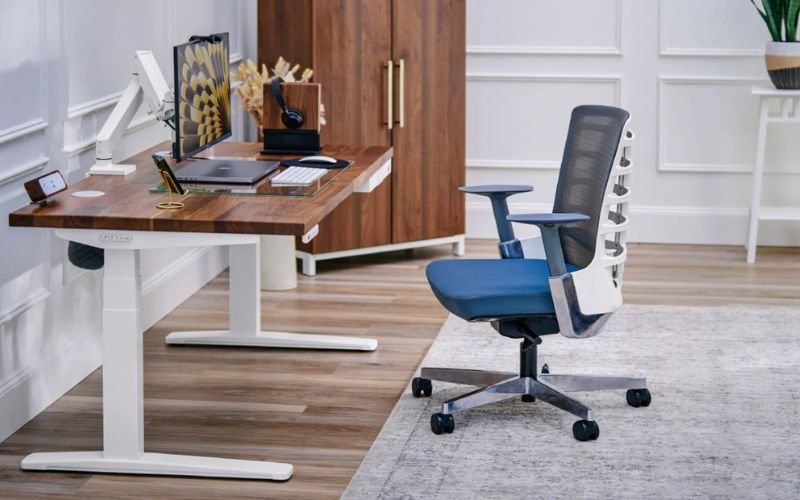
The UPLIFTV3 Standing Desk features three-section legs, offering a height adjustment range of 22.6 inches to 48.7 inches to meet the needs of most users.
Advanced anti-collision safety sensors automatically stop and reverse movement upon encountering obstacles, with adjustable sensitivity for personalized safety.
A powerful dual-motor system provides a lifting capacity of up to 355 lbs (approximately 160 kg), easily supporting a fully equipped desktop.
It raises and lowers at a rate of 2 inches (approximately 5 cm) per second, operating at less than 48 decibels, demonstrating industry-leading quiet performance.
Pros:
- Strong, molded steel base design ensures stability at any height.
- Equipped with a FlexMount cable manager for power and cable management.
- One-button adjustment to preset height.
Cons:
- Numerous accessories; assembly requires some time.
Specfications:
| Desktop Size | 41.3″ to 72.2″ L x 27.6″ W x 21.6″ to 47.7″ H |
| Height Range | 21.6 – 47.7 inches |
| Maximum Weight | 355 pounds |
| Warranty | 15 years |
5. FlexiSpot E7 Pro Standing Desk
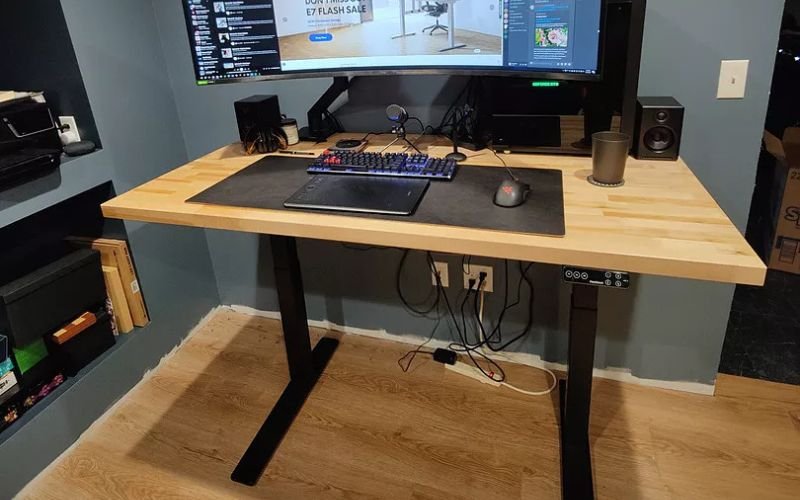
The FlexiSpot E7 Pro Standing Desk is the most stable desk in the FlexiSpot lineup. Its thickened, semi-C-shaped legs, combined with extended, overlapping uprights, provide robust support for your work.
Its advanced dual-motor drive ensures smooth and quiet operation—even quieter than typing. Tested over 30,000 times, it’s more than capable of handling intensive daily use.
A built-in charging port ensures your devices are fully charged and ready to go, allowing you to focus on your work. A locking safety feature effectively prevents accidental use by children or pets, ensuring home safety.
Pros:
- 4 memory preset options.
- Comprehensive cable management system keeps your workspace neat and professional from all angles.
- Made with industrial-grade steel, the desk is durable.
Cons:
- Higher price, no built-in storage or drawers.
Specfications:
| Desktop Size | 45.7″ x 10.9″ x 8.7″ |
| Height Range | 25.0 – 50.6 inches |
| Maximum Weight | 440 pounds |
| Warranty | 15 years |
Riser Desk VS Desk Riser
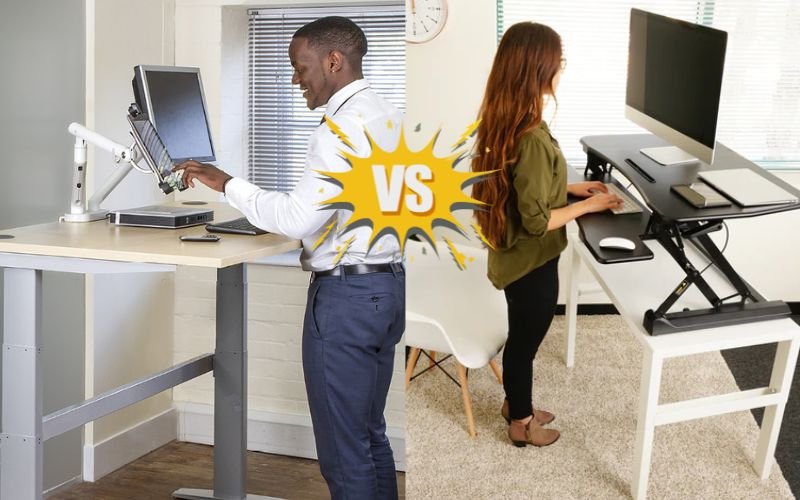
Many people easily confuse Riser Desk with Desk Riser, but they are actually two different height-adjustable solutions, and they are suitable for different needs.
| Features | Riser Desk | Desk Riser |
|---|---|---|
| Definition | A fully adjustable desk with the desktop and support lifted as a single unit | A lifting platform is placed on an existing desktop to elevate a laptop or monitor |
| Desktop Area | Large, can accommodate a computer, keyboard, multiple monitors, and office supplies | Small, suitable only for holding a monitor, a laptop, or a few office supplies |
| Height Adjustment Method | Electric or manual height adjustment with memory preset function | Gas spring or manual adjustment, usually without a memory function |
| Load Capacity | Higher capacity, can support multiple devices and heavy objects | Lower capacity, typically only suitable for lightweight equipment |
| Installation Method | A freestanding desk requires space and fixation | Place it on your existing desktop; no need to fix it in place; easy to move |
| Use Scenarios | Long-term office work, multiple monitors, multi-person workstations, healthy office work | Temporary use, short-term standing, home office, small desktop |
| Cost | High | Low |
| Advantages | Comprehensive ergonomic experience, free switching between sitting and standing, strong stability | Easy installation, flexible and movable, saves cost and space |
| Disadvantages | Large footprint, high cost, inconvenient to move | Limited desktop space, low load capacity, experience is not as good as a full-height adjustable desk |
Conclusion: What Is A Riser Desk?
Riser desks are an innovative type of office furniture that allows users to adjust their height to suit both sitting and standing postures, improving not only work comfort but also health and productivity.
Whether for home or office use, riser desks are an ideal choice for modern work environments.
For a healthier and more efficient work experience, consider Meet&Co Office Furniture‘s high-quality height-adjustable desks, allowing you to easily switch between sitting and standing positions and say goodbye to the discomfort of prolonged sitting.
Related Articles:
- Best Home Office Standing Desks 2025 For Productive Work
- How to Choose an Adjustable Standing Desk: An Ultimate Guide
FAQ
Q1: Do chiropractors recommend standing desks?
Chiropractors often recommend using uplift standing desks, which can improve posture and reduce pressure on the lower back, but it is necessary to alternate between sitting and standing and avoid standing for long periods of time.
Q2: Is it healthy to stand all day at a standing desk?
We should stand in moderation and consciously control the duration of each standing session. 30–60 minutes each time is ideal.
Q3: What is the 20 8 2 rule for standing desks?
The 20-8-2 rule means that for every 20 minutes of work, you should sit for 8 minutes, stand for 8 minutes, and engage in light physical activity for 2 minutes.
Q4: How long should you stand at a standing desk each day?
It is recommended to stand for 15–30 minutes every hour, accumulating to about 2 hours per day. Maintaining dynamic switching is more important than the length of time you stand.
Q5: How to use a desk riser?
Place the monitor and keyboard on the height-adjustable desktop stand and adjust the height using the handle or buttons. Once you find a comfortable line of sight and elbow angle, you can begin working.