
The majority of individuals choose a desk without considering the height. They simply take what is good to look at. However, an inappropriate desk height can cause long-term damage to your back, neck, and wrists.
The standard desk height should be between 28 and 30 inches (71-76 cm), which is appropriate for people with 5’8 “ to 5’10” height. But the vast majority are not in that range.
A standard desk can put you in awkward, unhealthy postures when you are taller or shorter. In the long run, it causes pain, stiffness, and even long-term or irreversible damage.
Through this guide you will learn the average desk height that suits your body, how to set up your desk properly, and what can simplify the entire process.

Why Does Desk Height Matter So Much?
Sitting at the wrong height puts stress on your whole body. Your neck tilts. Your shoulders hunch. Your wrists bend at the wrong angles.
A 2024 study found that among office workers, up to 75.5% reported low back pain from prolonged sitting at work.
That’s a big number. And a lot of that pain comes from poor desk setup, not just bad habits.
Here’s what bad desk height can cause:
- Neck discomfort: This is caused by bending your head up or down throughout the day, which exerts continuous stress on the cervical spine and can make it stiff over time.
- Shoulder tension: Due to hunching up or over-reaching, which makes your muscles remain taut longer than they should and makes them tight, sore, and less flexible.
- Strain on the wrist: That can cause carpal tunnel syndrome, particularly when you type or do long hours with the mouse in the wrong position.
- Lower back pain: Resulting in slouching or bending forward in a way that causes uneven pressure on your back and strains your support muscles, with the core support in the long term.
- Eye strain: Straining your eyes by staring at the screen at the wrong angle can make your eyes strain more, leading to dry eyes, headaches, and blurred vision.
Getting your desk height right won’t fix everything. However, it is among the simplest initial measures towards a healthier workday.
What is the average desk height?
In the USA, the average desk height is 28-30 inches. Most office desks sold today fall right in that zone.
But here’s the catch: this standard desk height is only suitable for people around 6 feet tall.
So if you’re not near 6 feet, a standard desk is already working against you.
Quick reference by height:
| Your Height | Ideal Sitting Desk Height |
| 5’0” | 24–25 inches |
| 5’4” | 25–27 inches |
| 5’8” | 27–29 inches |
| 6’0” | 28–30 inches |
| 6’4” | 30–32 inches |
These are not strict rules but entry points. Everyone’s body is different. The arm, torso, and leg lengths are all contributory factors.
How to Find Your Ideal Desk Height
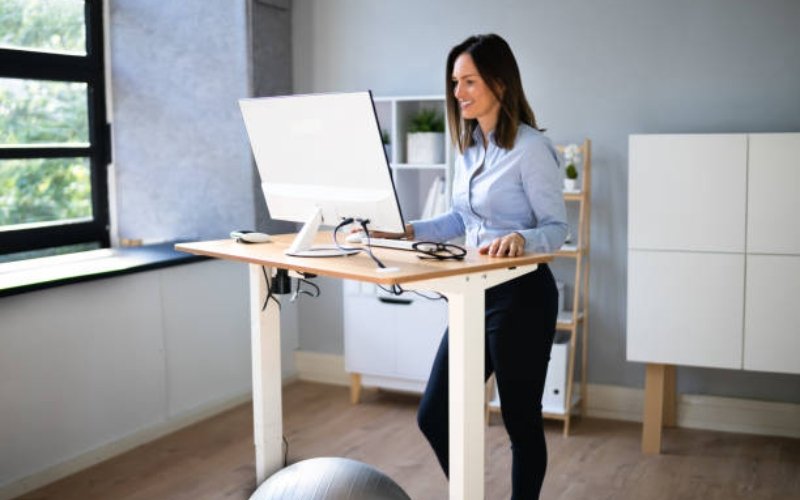
The best way to check your desk height? Use your elbows. Sit or stand comfortably. Measure the length of the distance between your elbows and the floor.
This figure is your comfort zone, your office, which indicates the ideal desk height for the office. Once you have that number, match it to your desk.
For sitting desks:
- Legs must be flat on the floor.
- Knees are expected to be 90 degrees.
- Forearms must be in a parallel position.
- Wrists should stay straight while typing.
For standing desks:
- Elbows at about 90–110 degrees
- Shoulders relaxed, not raised
- Screen at eye level or slightly below
- Weight balanced evenly on both feet
Your desktop needs to be at the same level as your elbows, whether you are sitting or standing.
Average Desk Height for Kids vs. Adults
Kids need lower desks. Their bodies are still growing, and forcing them to use adult-sized desks causes real harm.
Here are general guidelines for children:
| Age Group | Suggested Desk Height |
| 5–7 years | 20–22 inches |
| 8–10 years | 22–24 inches |
| 11–13 years | 24–26 inches |
| 14–17 years | 26–28 inches |
| Adults | 28–30 inches |
The most important principle is that the height of the desk when sitting must be equal to the elbow height.
Sitting vs. Standing Desk Height
Standard desks are fixed. You set them up once, and they stay that way.
Standing desks, especially electric ones, let you adjust throughout the day.
Why does that matter?
Research from Cornell University suggests a 20:8:2 ratio: for every 30 minutes at your desk, sit for 20 minutes, stand for 8, and move around for 2.
A fixed desk forces you to stay in one position. An adjustable desk lets you switch, which is much better for your body.
Most sit-stand desks in the market today have desktops that move within a height range of 28” to 47” from the floor.
Such a range suits the majority of adults. However, if you are petite (below 5 feet 4 inches), look for desks that lower to at least 23 inches.
Indicators: Your Desk Is an Inappropriate Height
Not sure if your desk height is off? Your body will tell you.
Your desk is too HIGH if you:
- Raise your shoulders to reach the keyboard
- Feel tension in your upper back and neck
- Have wrists that tilt upward while typing
Your desk is too LOW if you:
- Lean or hunch forward constantly
- Feel lower back pain by midday
- Have to drop your head to see the screen
Too low? You’ll feel slouched over. Too high? Uncomfortable, too. When you see any of these signs, then it is time to change.
Guidelines to Establish an Ergonomic Workstation
The correct desk height is only half the battle. The whole setup matters.
Chair:
- Adjust so your feet rest flat on the floor
- Set seat height so knees are at 90 degrees
- Use lumbar support to protect your lower back
Monitor:
- The top of the screen should be at or just below eye level
- The screen should be about arm’s length away
- Tilt it slightly upward (10–20 degrees) to reduce glare
Keyboard and mouse:
- Keep them close to your body
- Wrists must not be raised or lowered.
- Think about a wrist rest during long typing.
Lighting:
- Avoid glare on your screen
- Use natural light where possible
- Add a desk lamp for task lighting
Meet the Sendi Electric Standing Desk by Mige Furniture
A height-adjustable desk is the intelligent investment you can ever make if you are serious about your desk ergonomics.
And one product can be distinguished by the combination of quality, flexibility, and value.
The Sendi Electric Standing Desk
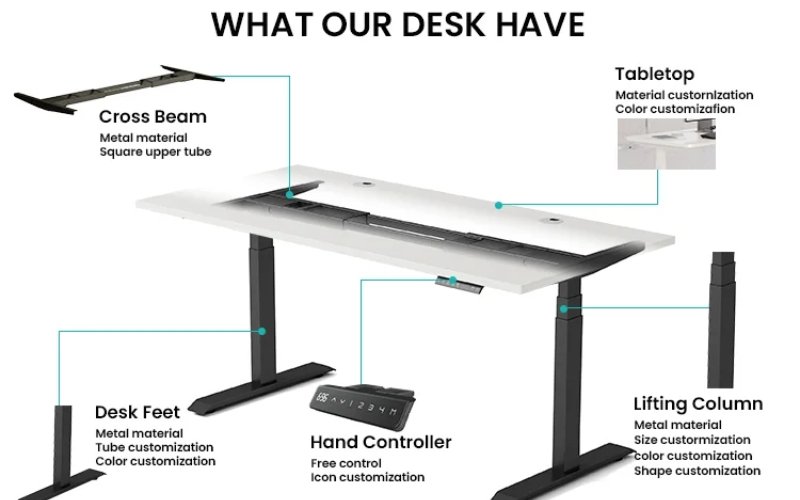
The Sendi is made by Meet&Co Furniture — a brand with over 8 years of experience in ergonomic office furniture. It’s designed for people who want a professional-grade desk without the premium price tag.
Key Features:
- Dual motor system — smooth, quiet height adjustment every time
- 3-stage lifting columns — wider height range for more body types
- Memory controller — save your preferred sitting and standing heights
- E1-grade MFC desktop — 25mm thick for strong, stable load-bearing
- Metal cable management tray — keeps your workspace tidy
- Built-in USB port — charge your devices while you work
- Available in black, white, and grey — fits any office style
- Adjustable from sitting to standing — with whisper-quiet operation below 50 dB
- 3-year warranty included
The Sendi moves at 40mm per second — fast enough to switch positions without breaking your focus. Even at its maximum height, it stays steady. No wobble. No interruptions.
It’s available in multiple desktop sizes so that you can pick the right fit for your space.
Who is it for?
The Sendi works well for:
- Remote workers setting up a home office
- Employees spending 6 or more hours in the office.
- Individuals with back or neck pain.
- Whoever desires to be more productive and healthier at work.
How to Use a Standing Desk the Right Way
Buying a standing desk is step one. Using it correctly is step two.
A lot of people make the mistake of standing all day. That’s just as bad as sitting all day.
The golden rule: alternate!
Research shows that our bodies thrive when we stand for 1 to 2 hours for every 1 hour we sit.
Start small. Stand for 15–20 minutes at a time. Build up to longer sessions as your body adjusts.
Standing desk best practices:
- Set it to elbow height when standing — same rule as sitting
- Wear supportive shoes or use an anti-fatigue mat
- Keep your screen at eye level
- Shift your weight and move your feet regularly
- Avoid locking your knees, keep a slight bend
The Sendi’s memory presets make this easy. You set your sitting and standing heights once each. Then switch with a single button press.
Common Desk Height Mistakes to Avoid
Even with the right desk, poor setup habits can still lead to discomfort and long-term strain.
Here are the most common mistakes to watch for and how to fix them:
- Using a “standard” height without measuring: Relying on fixed desk heights ignores body differences. Always set your desk at elbow level to keep your arms relaxed and aligned.
- Ignoring chair adjustments: An unadjusted chair disrupts posture. Ensure your feet are flat, knees are at 90 degrees, and your back is supported so your desk setup works effectively.
- Overlooking monitor position: A poorly placed screen strains your neck and eyes. Keep the monitor at eye level and an arm’s length away for comfort.
- Standing without movement: Standing still for too long causes fatigue and poor circulation. Alternate between sitting and standing, and move regularly to reduce strain.
- Forgetting about footwear: Shoes affect your height and posture. Wearing different footwear can misalign your setup, so adjust desk height accordingly or maintain consistent work shoes.
Small adjustments make a big difference. Taking just a few minutes to fine-tune your workspace can improve comfort, boost productivity, and help prevent long-term health issues.
FAQs
How do I tell whether my desk height is right?
Sit at your desk in a good posture. Your forearms should be at approximately 90 degrees, with your elbows parallel to the floor. Otherwise, your desk is either too high or too low.
What is the recommended standing desk height?
Your desk surface must be parallel to your elbow height when upright, just as when seated. To the majority of the adults, that is 38 to 47 inches.
Am I suitable for a 30-inch desk height?
A 30-inch desk is appropriate for individuals who are 6 feet tall. If you are shorter, you might need a lower desk or a chair with a footrest.
Will the wrong desk height result in back pain?
Yes. The studies have consistently linked poor desk ergonomics with neck ache, back pain, and shoulder tension. One of the simplest ways to avoid such problems is to get the height right.
Is it worth it to have an electric standing desk?
Yes, to the majority of the long-sitters. Switching between sitting and standing during the day is a difference that really counts in terms of comfort and, in the long run, health.
Final Thoughts
The average desk height of 28–30 inches was designed for a specific body type. If that’s not your body, it’s not your desk.
The good part is that the fix is simple. Measure your elbow height. Set your desk to match. Add a good chair, position your monitor correctly, and switch between sitting and standing throughout the day.
If you’re ready to take your workspace seriously, the Sendi Height Adjustable Electric Standing Desk gives you everything you need. It’s adjustable, quiet, durable, and built for real people, not just the 6-foot standard.
Upgrade Your Workspace
Don’t let the wrong desk height hold you back. Take 5 minutes to measure, adjust, and feel the difference. Shop the Sendi Electric Standing Desk by Meet&Co Furniture, and start working smarter, not harder.


