
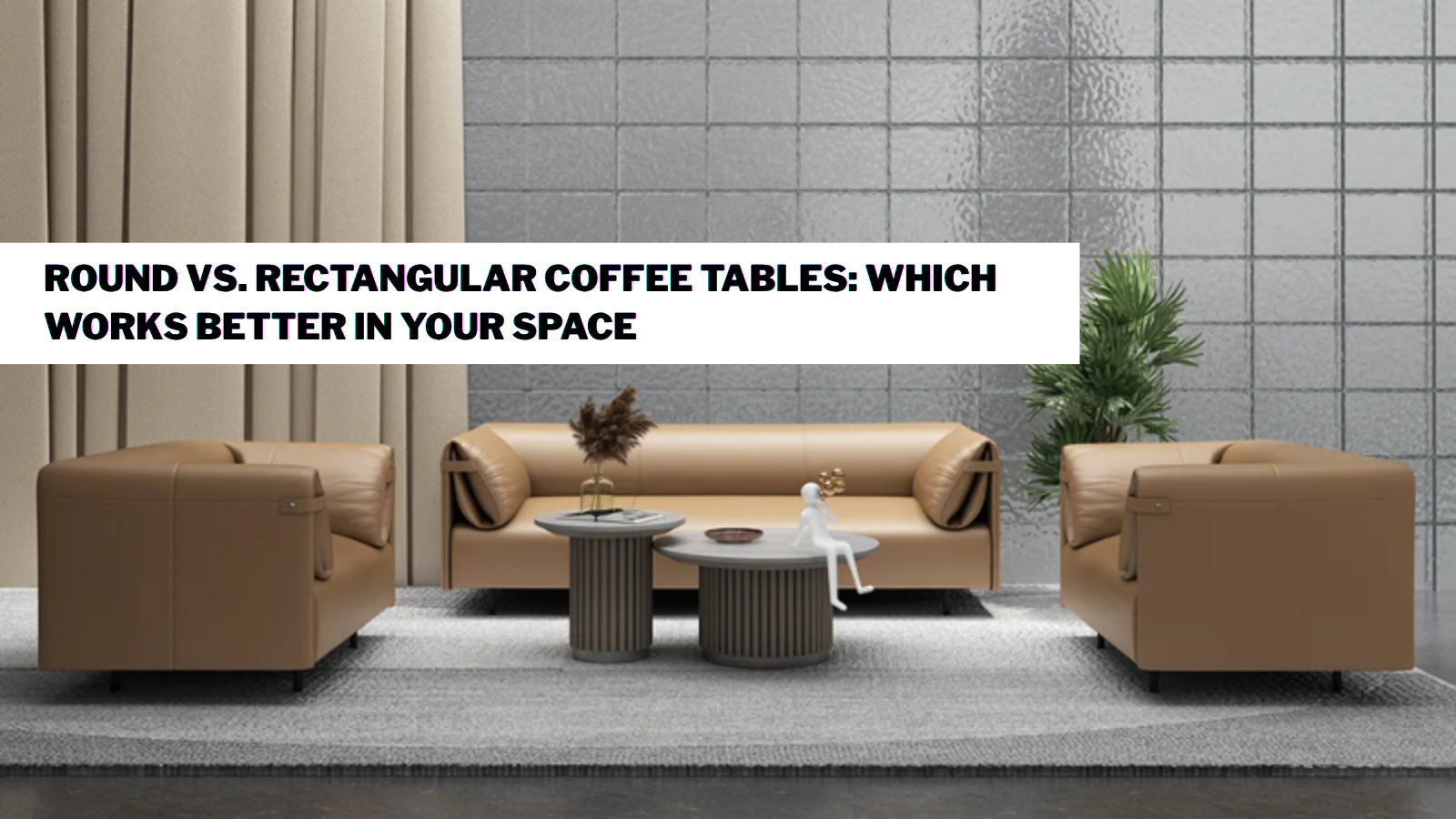
A coffee table may seem like a small detail, but its shape can influence how a seating area looks and functions. Round and rectangular coffee tables are both common choices, yet they suit different furniture arrangements and space requirements. Whether you’re furnishing an office lounge, a reception area, or a living room, the right coffee table shape depends on your seating arrangement, available floor space, and how people move around the furniture.

Key Takeaways
- Round coffee tables can work well in seating arrangements organized around a central point and offer a shape without corners.
- Rectangular coffee tables often pair naturally with long sofas and linear seating layouts.
- The right shape depends on available floor space, walking paths, seating arrangements, and how the table will be used.
- Oval, square, and irregularly shaped coffee tables are also worth considering when round and rectangular designs do not suit your layout.
Round vs. Rectangular Coffee Tables at a Glance
The main difference between round and rectangular coffee tables lies in their shape and how they relate to the surrounding furniture. Neither shape is automatically better; the more suitable option depends on the layout and the space available.
| Feature | Round Coffee Table | Rectangular Coffee Table |
| Shape | Circular outline with no corners | Elongated outline with four corners |
| Typical proportions | Diameter 28–40″, visually compact, soft outline | Length 40–60″, slimmer width, strong linear presence |
| Seating reach & serving area | Great central reach for everyone; slightly less surface per inch | Maximum surface along the sofa; |
| Best sofa pairings | Sectionals, curved sofas, U-shaped or conversation groupings | Standard 3-seaters, sofas with chaise, long modular or deep sofas |
| Safety | No sharp edges, great for families; easier in tight walkways | Sharp corners, less ideal for homes with kids; corners can be bump points unless softened or rounded |
| Social Interaction | Encourages conversation and inclusivity | More structured seating arrangement |
| Storage Options | Limited built-in storage | Often includes drawers, shelves, or lift-tops |
| Aesthetic Impact | Softens angular furniture, creates visual balance | Provides structure and a clean, minimalist look |
It is also important to distinguish shape from size. A small rectangular table may take up less floor space than a large round one, while a wide round table may offer more surface area than a narrow rectangular model. Comparing actual dimensions is therefore more useful than choosing based on shape alone.
How Shape Changes the Way You Move
Moving around a coffee table should feel natural rather than require people to squeeze between furniture or repeatedly change direction. Round tables have no corners, so there are fewer angular edges to navigate around. This can be helpful in areas where people approach the table from different sides, although the table still needs sufficient clearance to avoid obstructing movement.
Rectangular tables require more attention to their corners, especially when placed near walkways or frequently used entrances. A corner that extends into a narrow passage can become inconvenient, even if the table itself fits within the room. Positioning the table carefully and checking the distance between it and nearby seating can help prevent these problems.
The floor area occupied by a table is only part of the equation. People also need room to sit down, stand up, and reach the tabletop without awkward movements. Before purchasing either shape, mark out its approximate dimensions on the floor if possible. This simple step can reveal whether the table will interfere with doors, walking routes, or the normal use of nearby furniture.
When Does a Round Coffee Table Work Better?
One practical reason to choose a round coffee table is its lack of corners. In a busy household or a shared lounge, this design removes the sharp corners found on rectangular tables. It may be worth considering when people frequently pass close to the table, although the overall risk of bumps and collisions also depends on the table’s size, height, material, and placement.
If a room has many straight edges, a round coffee table can balance the visual effect. Its curved outline introduces a different shape without requiring major changes to the existing furniture. This can be useful in an office lounge where the surrounding furniture has a formal or geometric appearance, but the seating area needs a slightly softer visual touch.
A round table can be convenient when people sit in chairs positioned at different angles around it. Because there is no designated long side, the tabletop can be approached from several directions. This arrangement may suit casual conversation areas, small waiting lounges, or seating groups that use individual armchairs rather than one long sofa.
When Does a Rectangular Coffee Table Work Better?
A rectangular coffee table can be useful when the table needs to provide a longer surface for several items. Drinks, magazines, remote controls, and other everyday belongings can be arranged along its length rather than concentrated in one area. In an office lounge or reception space, this can make the tabletop convenient for visitors sharing the same seating area.
Rectangular coffee tables often pair naturally with long sofas because their proportions can follow the length of the seating. This can create a balanced look and provide access to the tabletop from different parts of the sofa. The table does not need to match the sofa’s full length; instead, its dimensions should leave enough room at the sides and in front for comfortable movement.
This shape can also work well with modular sofas and reception seating made up of several connected sections. When choosing a table, consider the complete seating arrangement rather than one individual seat. The goal is to provide convenient access to the tabletop without making the area feel crowded or leaving some seats too far away.
Limitations of Rectangular and Round Coffee Tables
A major limitation of round coffee tables is usable surface area. A small round table may be sufficient for a cup of coffee and a few personal items, but it may feel limited when several people need to use it at the same time. Increasing the diameter can provide more space, but it also increases the table’s footprint. The right balance depends on both the intended use and the available room.
Rectangular coffee tables have their own limitations. Their corners can become obstacles in tight walkways, particularly when the table is positioned close to frequently used paths. Their elongated shape may also feel out of proportion in a compact seating area or in a layout built around individual chairs rather than a long sofa.
The Other Different Shapes of Coffee Tables
Round and rectangular coffee tables are not the only choices. Depending on the room’s proportions, the surrounding seating, and your preferred interior style, other shapes may offer a better fit. The following options each have distinct characteristics worth considering.
Oval coffee tables
Oval coffee tables combine an elongated tabletop with rounded ends. They can suit longer sofas while offering a softer outline than a rectangular table. Because they have no pointed corners, they may also be worth considering when people need to pass around the ends of the table. As with any design, the overall length and width should still leave enough room for movement.
U-Shaped coffee tables
U-shaped coffee tables feature a tabletop or frame that forms a U-shaped outline, although the exact design varies by model. Some designs can partially surround a sofa section or fit around another piece of furniture, while others create an open area within the table’s outline.
This shape can be useful when the layout calls for a distinctive form or a specific way of arranging objects, but it is important to check the table’s dimensions and how its open section relates to the surrounding seating.
Irregular or organic-shaped coffee tables
Irregular or organic-shaped coffee tables use asymmetrical curves and free-flowing outlines rather than standard geometric forms. They can add visual variety to a room and work well as a design feature when the surrounding furniture is relatively simple. Their unconventional outlines may make exact placement and coordination more challenging, so it is useful to check the tabletop dimensions and the space required around the widest parts of the design.
Conclusion
So, which works better: a round or rectangular coffee table? A round design may suit seating arranged around a central point, while a rectangular one often fits long sofas and linear layouts more naturally. Neither is universally better, so consider the dimensions of your space, the furniture around the table, and how people will use the area before making a decision.
For office lounges and reception areas, the coffee table should complement the seating and support the way people use the space. Meet&Co brings together office furniture design and manufacturing experience, with a focus on durability and aesthetics. When planning a workspace, consider how the coffee table, lounge seating, and surrounding furniture work together to create a practical and cohesive environment.


